

In observance of the tenth anniversary of Bowie's return to the stars, I am posting the eulogy I wrote on that fateful day...
The story has been told, its ending could not have been more perfectly constructed or executed. It's been said that the great ones know when to leave the stage. the Greatest also know how.
A little less than three years ago, David Bowie released what I called "The Last Rock 'n' Roll Album," and pulled off what some critics labeled the greatest comeback since Elvis in '68.
Hardcore Bowie fans like myself were a bit nonplussed by the critical response to The Next Day -- not because we didn't appreciate the praise, but because we wondered where these critics had been hiding while Bowie had been making important music both onstage (The BBC Radio Concert, the Reality DVD, for starters), and in the studio (see Outside, Earthling, Heathen).
Fewer still expected him to follow that up with Blackstar, an experimental set of jazz-inflected post-rock designed to serve as his epitaph.
The effect was only cemented by 'Golden Years' and 'Sound and Vision', which stood out like holographic intruders on the old daguerreotype of the AM radio Top 40 wasteland.
My shelves are now filled with Bowie biographies, but then I had no idea how utterly alien this man was. How the albums that redefined the course of popular music seem to burst fully formed from his fevered brain to the literal astonishment of his collaborators.
How he spent countless hours immersed in his occult library, or skywatching for UFOs, all the while painting, writing in his journals, studying dance or boxing and later, appearing in more films than most professional actors, until such time as it came to lay down another indelible classic.
It's not a stretch to say that music was being channeled through him.
How he spent countless hours immersed in his occult library, or skywatching for UFOs, all the while painting, writing in his journals, studying dance or boxing and later, appearing in more films than most professional actors, until such time as it came to lay down another indelible classic.
I can still remember buying Stage at Jason's Music and Luggage (!), which seems unloved today, but for me was like finally stepping into that parallel dimension. I should add that I was on my way home from theatre class at the time, having briefly humored acting fantasies.
It was here I'd be initiated into the Mysteries of Sound that so bewitched Philip K Dick: Bowie and Eno's synth-driven symphonettes from Low and Heroes. Dick was so enraptured by this music he saw it as some kind of alien transmissions converted to vinyl through a kind of modern electronic alchemy. Or, as Dick called it, "synchronicity music."

Bowie and The Man Who Fell to Earth had such a powerful effect on Dick's emerging awakening that they became major players in the first allegorical exegesis of his spiritual journey, Valis -- the film within the novel was based on Dick's experience of seeing Earth for the first time and how it seemed to resonate so completely with his own inner turmoil.
There was a dividing line now: it was Year Zero. Punk, Post-punk, New Wave, and the rest were the new vanguard, the Great Wheel had turned. Only Bowie and his fellow travelers (Fripp, Eno, Iggy, etc) would seem relevant in the new regime.
But Bowie had other plans. He'd released his now-legendary string of classic albums under constant threat of financial insolvency (the great Spiders from Mars lineup broke up because of financial pressures), thanks in large part to the drain on his accounts by his management team, who burned through his profits either with their endless partying and extravagance or by trying to launch hopeless careers.
He'd seen a new generation of artists getting rich off of his ideas and now he wanted to cash in. During the sessions for 'Under Pressure,' Queen sold Bowie on the benefits he could reap by dumping the moribund RCA for the ravenous EMI, who'd made plutocrats out of the glam foursome.
With an eye on the success The Rolling Stones and The Police were having touring large stadiums, Bowie set his sights on American superstardom. Then he entered the studio with Chic mastermind Nile Rodgers and a new backing band which included rising star Stevie Ray Vaughn on guitar. The result was Let's Dance, a bonafide blockbuster that finally put Bowie in the top rank where he and his fans felt he belonged.
He'd seen a new generation of artists getting rich off of his ideas and now he wanted to cash in. During the sessions for 'Under Pressure,' Queen sold Bowie on the benefits he could reap by dumping the moribund RCA for the ravenous EMI, who'd made plutocrats out of the glam foursome.
Oh, but the price to pay.
Signs that Bowie was as bored with his new role as his 70s fans were were confirmed by a long (for the time) post-Tonight silence punctuated only by a few weak soundtrack numbers.
He re-emerged in 1987 with Never Let Me Down, an album that tried too hard to recapture Let's Dance's formula but buried a lot of worthy songs in the histrionic production techniques of the time. He compounded the felony with the Glass Spider tour, a half-hearted return to the theatricality of the Diamond Dogs era, only without the zeitgeist, and with 75% more cringe. Plus, Peter Frampton.
Bowie then hooked up with Iggy's old rhythm section (the Sales brothers, as in Soupy) and new guitarist Reeves Gabrels for Tin Machine, but it looked and sounded like the overwrought midlife crisis it actually was. A reunion with Nile Rodgers seemed promising, but then his new record company went bankrupt as soon as Black Tie/White Noise was released.
INTERLUDE: 'I've been interested in the Gnostics.'

"Now the archon who is weak has three names. The first name is Yaltabaoth, the second is Saklas, and the third is Samael. And he is impious in his arrogance which is in him. For he said, `I am God and there is no other God beside me,' for he is ignorant of his strength, the place from which he had come..." THE APOCRYPHON OF JOHN
It wouldn't be until Bowie abandoned his grasping for the mainstream and got his freak back on that he'd rediscover his Bowieness. A soundtrack for the British TV series The Buddha of Suburbia got Eno's attention again, and the old mates took to the studio to record 1.Outside, a sprawling, deliciously-pretentious slab of 200-proof Bowie, replete with a ludicrous "concept" based on transgressive art, millennial angst, and ritual murder.
The planned-for trilogy never materialized, as Eno continued his career as megahit-making producer. So Bowie returned with Earthling, where then-trendy techno-disco dribblings were grafted onto classic Bowie melodies. Luckily, most of the songs survive the procedure.
Whether because of the realities of the new market or simple maturity, Bowie dropped the attempts to appeal to the dissipating younger market and made a classic Bowie album, a return to old-fashioned songcraft without any trendy bells and whistles. A new and larger band was assembled, and Bowie began touring and doing various media appearances.
The effect of Heathen was mitigated by the followup Reality (2003), which in fairness may have been recorded to secure tour financing. A live DVD of the marathon Reality tour bolsters that suspicion, but unfortunately the stress of the road on the 56-year old performer resulted in the aforementioned coronary event, leading us back to the long radio silence.
THE SECRET BOWIE
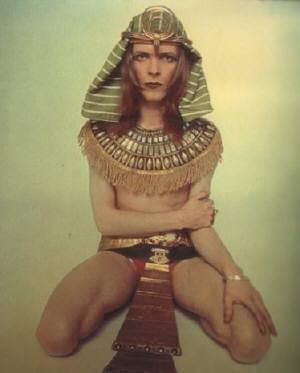
Bowie himself has always been cagey about his occult interests, preferring to keep an aura of uncertainty and mystery (much like his contemporary Jimmy Page, with whom he shares a birthday). All of this mystery and play will become very important shortly.
From 1997:
So were you involved in actual devil worship?"Not devil worship, no, it was pure straighforward, old–fashioned magic."The Aleister Crowley variety?"No, I always thought Crowley was a charlatan. But there was a guy called [Arthur] Edward Waite who was terribly important to me at the time. And another called Dion Fortune who wrote a book called 'Psychic Self–Defence'. You had to run around the room getting bits of string and old crayons and draw funny things on the wall, and I took it all most seriously, ha ha ha !
I drew gateways into different dimensions, and I'm quite sure that, for myself, I really walked into other worlds. I drew things on walls and just walked trough them, and saw what was on the other side!"

Less ambivalent is Bowie's obsession with UFOs, which dates back to his time as a UFO watcher in London and lurks throughout his entire recorded catalog, from 'Memory of a Free Festival' in 1969 to 'Born on a UFO' in 2013, and all points in between (possibly on the new album, I'm not sure yet).
Such was Bowie's alien mystique that a whole corpus of legend surrounding Bowie, UFOs and ETs arose in the rumor mill:
"Extraterrestrials had been in the audience during his concerts at the Los Angeles Amphitheatre [in September 1974]. People had mistaken them for the Bowie clones he attracted. The silver pentagrams marked on their foreheads had been interpreted as attempts to imitate his own facial decoration. But he had distinguished his own. They were there and their eyes never left him. He had counted twenty. He was terrified they would come backstage. The time wasn't right. His act had still to be perfected, enhanced, taken to ultimate extremes. [Jeremy Reed: "Diamond Nebula", London 1994, p. 68] |
Given the immense stellar distances, he might not travel physically but through some form of astral travel, using technology we can guess at. He might take refuge in a human being, preferably a fetus in which the personality has not yet formed.
He may do so in 1947, the year of Roswell and Kenneth Arnold, and may do so in London, a world capital filled with people calling out to the stars. He'd fill that host with powers far beyond those of ordinary humans and an insatiable need to experience as much of the world as possible, like what an international celebrity with a storming libido might do.
But these powers may not be suitable for the human host and might begin to take their toll at a relatively early age, say in the host's mid-fifties. It might also lead to a relatively early death. But it might also rally the host for one last great burst of productivity, including an epitaph to its presence here on Earth.
I mean, just total speculation here. Those kind of things don't happen in the real world. Right?
He may do so in 1947, the year of Roswell and Kenneth Arnold, and may do so in London, a world capital filled with people calling out to the stars. He'd fill that host with powers far beyond those of ordinary humans and an insatiable need to experience as much of the world as possible, like what an international celebrity with a storming libido might do.
Click here to read more |


No comments:
Post a Comment
Tell me your secret history.